
It’s a frustratingly common story we hear from sales leaders: “We sent the team to another great training program… and six months later, nothing has really changed.”
Despite spending thousands (sometimes millions) per year on sales training, many organizations see little lasting improvement in quota attainment, win rates, or revenue. The reps go through the workshop, get excited for a week or two, and then slowly slide back into old habits.
Why do sales teams fail even after attending multiple sales training programs?
The issue usually isn’t the quality of the training itself. It’s what happens (or doesn’t happen) afterward.
In our work helping B2B sales organizations, we’ve identified the most common hidden reasons training investments don’t deliver and more importantly, what actually works to make the learning stick.
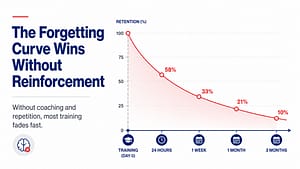
1. The Forgetting Curve Wins Without Reinforcement
This is the biggest silent killer. Research going back to Ebbinghaus shows people forget roughly 70% of new information within 24 hours and up to 90% within a month if there’s no deliberate reinforcement.
A two-day workshop might feel impactful in the moment, but without spaced repetition, real-world application, and coaching, the knowledge evaporates. By day 120, 85-90% of sales training has no lasting impact in many organizations.
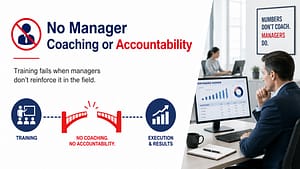
2. No Manager Coaching or Accountability
Managers are supposed to be the bridge between the training room and the field. Yet many have never been trained on how to coach effectively. They review pipeline numbers instead of call recordings. They give vague advice instead of specific, behavior-focused feedback.
Without consistent coaching from frontline managers, reps don’t translate concepts into habits. The middle 60% of the team, where the biggest gains are possible, gets almost no targeted development.
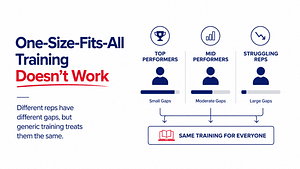
3. One-Size-Fits-All Training Ignores Individual Gaps
Generic programs treat every rep the same, even though skill levels, experience, and territories vary wildly. Top performers get bored, strugglers get overwhelmed, and the content rarely matches the exact challenges of your complex deals or industry.
4. Training Focuses on Knowledge, Not Behavior Change
Many programs excel at teaching “what” and “how” (methodologies, objection handling, discovery questions) but fall short on helping reps actually do it differently on live deals. Without deliberate practice, role-plays tied to real opportunities, and post-training reinforcement, old behaviors win.
Quick Read – Sales Training vs Sales Coaching for Organizations: When & What to Opt for in 2026
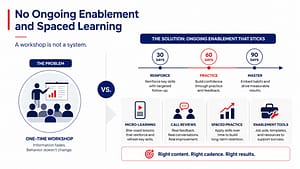
5. Lack of Ongoing Enablement and Spaced Learning
Sales training is often treated as a one-and-done event instead of a continuous process. There’s no system for refreshers, micro-learning, win/loss reviews, or just-in-time tools that reps can access when they need them most right before a big call or during a stalled deal.
6. Poor Alignment with Real Sales Process and Culture
If the training doesn’t match your actual sales process, CRM usage, or company culture, it feels theoretical and gets ignored. Reps quickly revert to what’s comfortable (and what gets rewarded day-to-day).
7. No Measurement of Real Behavior Change or Business Impact
Too many organizations only track completion rates or “smile sheets.” They don’t measure whether reps are actually using the new skills (e.g., better discovery questions on calls) or whether it’s moving the needle on win rates and revenue. Without clear metrics and accountability, there’s no pressure to change.
Suggested Read – 7 Underrated Reasons Most Sales Teams Miss Their Targets (And How to Fix Them)
How to Make Sales Training Actually Stick
The organizations that break this cycle do a few things differently:
- Treat training as the start of the journey, not the finish. Build in 30/60/90-day reinforcement plans with coaching cadences.
- Train and equip managers to coach. This single investment often delivers the highest ROI.
- Personalize where possible and tie learning directly to live deals.
- Use spaced repetition, role-plays, call reviews, and enablement tools for ongoing support.
- Measure leading indicators (skill adoption, conversation quality) alongside lagging ones (revenue, quota attainment).
We’ve seen teams go from stagnant performance to consistent quota-beating results once they stop treating training as an event and start treating it as a system supported by coaching and accountability.
Sales training has strong potential ROI (often cited around 353% when done well), but only when paired with the right reinforcement. The difference between “we did another training” and “our team finally leveled up” comes down to what happens after the workshop ends.
If your sales team has been through multiple programs with disappointing results, it’s probably not a motivation or talent problem, it’s a reinforcement and coaching problem. Fix the system, and the training investment finally pays off.