
If you lead a sales team, you’ve probably asked this question more than once: Should we invest in sales training or sales coaching?
The truth is, these two approaches are often lumped together, but they serve very different purposes. Getting the mix wrong is one of the most common (and expensive) mistakes organizations make when trying to improve sales performance.
In our work with B2B sales teams, we’ve seen companies pour money into one-off training workshops with little lasting impact, while others unlock significant gains by combining training with ongoing, deal-specific coaching. The difference often comes down to understanding what each approach actually delivers and when to use it.
Here’s a clear, practical breakdown to help you decide what your organization actually needs.
Sales Training vs Sales Coaching: The Core Difference
At a high level:
- Sales training is about transferring knowledge and building foundational skills across a group. It answers the question: “Do our reps know what to do and how to do it?”
- Sales coaching is about developing individual performance in real-world situations. It answers: “Why aren’t they doing it, and how can we help them improve on actual deals?”
Training is typically structured, event-based or program-based (workshops, e-learning modules, onboarding programs). It covers product knowledge, sales methodologies, objection handling, discovery frameworks, and tools.
Coaching is ongoing and personalized. It happens in 1:1 conversations, deal reviews, call debriefs, and live feedback. A good coach helps reps apply what they know, close specific performance gaps, and build better habits over time.
One useful way to think about it: Training puts knowledge in. Coaching pulls performance out.

When Sales Training Is the Right First Move
Sales training shines in these situations:
- Onboarding new hires: New reps need foundational knowledge fast. A structured training program accelerates their ramp time and reduces early mistakes.
- Rolling out a new methodology or process: Whether you’re adopting Challenger, implementing a new qualification framework, or launching a new product line, training creates a shared language and baseline across the team.
- Addressing broad skill gaps: If most of your team struggles with discovery, negotiation, or handling objections, group training is an efficient way to lift the floor.
Important caveat: Training alone has a notoriously short shelf life without reinforcement. Research consistently shows that without ongoing coaching and enablement, much of what’s learned in a workshop is forgotten within weeks.
Read More – 5 Reasons Fractional Sales Consulting Makes Sense for Early-Stage B2B Startups
When Sales Coaching Delivers Far Greater Impact
This is where many organizations under-invest, and where the biggest performance lifts often come from.
Sales coaching is most effective when:
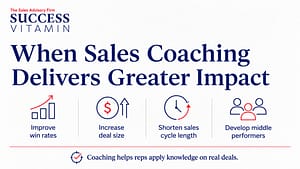
- Reps already have the foundational knowledge but aren’t applying it consistently on real deals.
- You want to improve win rates, deal size, or sales cycle length through better execution.
- You’re trying to develop middle performers (often the biggest opportunity for team-wide gains).
- Deals are complex, consultative, or involve long sales cycles and multiple stakeholders.
Weekly coaching, for example, has been shown to drive dramatically higher quota attainment compared to quarterly or ad-hoc coaching. The best coaching isn’t generic motivational talk, it’s specific, deal-focused, and behavior-oriented.
One insight we see repeatedly: Many sales managers think they’re coaching when they’re actually just reviewing numbers or giving advice. True coaching requires listening to calls, asking powerful questions, and helping reps develop their own thinking. Most managers have never been trained on how to do this well.
The Winning Approach: Don’t Choose, Blend (But Get the Sequence Right)
The organizations seeing the strongest results don’t pick one over the other. They use both strategically:
- Start with training to build shared foundations and language.
- Follow immediately with coaching to drive application and behavior change on real opportunities.
- Train your managers to coach — This is often the highest-leverage investment. A manager who can coach effectively multiplies the impact of every training investment.
We’ve seen companies transform results by moving from “annual sales kickoff + occasional workshops” to a continuous model of training + embedded coaching + manager development. The ROI shows up in higher win rates, faster ramp times for new reps, and more predictable forecasting.
Quick Read – 7 Sales Hiring Mistakes B2B Founders Make Under Growth Pressure (And How to Avoid Them in 2026)
How to Decide What Your Team Needs Right Now
Ask these questions:
- Do most reps lack core skills and knowledge? → Prioritize training (with coaching reinforcement).
- Do reps know what to do but aren’t consistently doing it on deals? → Prioritize coaching.
- Are you launching something new (product, process, methodology)? → Start with training, follow with coaching.
- Is your sales cycle long and complex with high deal values? → Lean heavier on coaching — context and judgment matter enormously here.
- Do your managers know how to coach effectively? → If not, invest in manager coaching training before anything else.
Final Thought
Sales training and sales coaching are not interchangeable. Training builds capability. Coaching converts capability into consistent performance.
The most effective sales organizations in 2026 treat them as complementary parts of a single system, not competing budget items. They invest in training to create the foundation, coaching to drive real behavior change, and manager development to make the whole system sustainable.
If you’re evaluating where to invest your sales development budget this year, start by getting clear on the specific performance gaps you’re trying to close. The right answer usually isn’t “training or coaching.” It’s “both, in the right order, with the right focus.”