
Hiring a new salesperson should feel like a win. You post the role, talk to some impressive candidates, make an offer, and finally get some help on the revenue side.
Yet for far too many organizations, that new hire ends up being one of the most expensive decisions they make all year. The rep struggles to ramp, misses targets, or quietly leaves within 6–12 months. The real cost, salary, recruiting fees, lost pipeline, and team morale, easily climbs into the hundreds of thousands.
How most organizations are hiring sales teams the wrong way usually boils down to a handful of habits that feel completely reasonable at the time. In our work with B2B companies building and scaling sales teams, these patterns show up constantly.
Here’s what we see happening far too often, and what actually works instead.
1. Chasing Impressive Resumes Instead of Real Fit
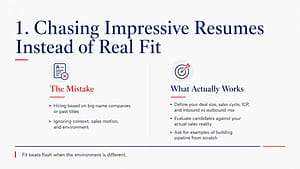
It’s tempting to hire the person who crushed it at a big-name company. “They closed seven-figure deals there, they’ll do great here too.”
The problem is context. Someone who thrives with strong brand support, inbound leads, and mature enablement often struggles in a founder-led environment where they have to hunt for every opportunity.
What we recommend instead: Get crystal clear on your sales motion first, deal size, sales cycle, ICP, outbound vs inbound balance. Then evaluate candidates against that reality, not just their past logos.
Dig into specific examples: “Tell me about a time you had to build a pipeline from scratch…”
2. Rushing the Process Because Revenue Feels Urgent
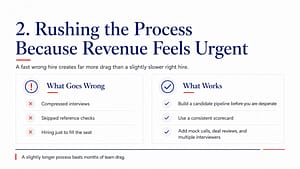
When the team is behind on targets, leaders compress interviews, skip deep reference checks, and hire quickly “just to get someone in the seat.”
We’ve watched this backfire more times than we can count. The short-term relief turns into months of drag on the entire team.
Better approach: Build a candidate pipeline before you’re desperate. Use a consistent scorecard with skills assessments, practical exercises (mock calls, deal reviews), and multiple interviewers. A slightly longer process with the right person beats a fast wrong hire every single time.
Quick Read – How a Fractional Sales Leader Fixes Broken Sales Pipelines
3. Relying Mostly on Interviews and Gut Feel

Salespeople are professional persuaders. Many interview brilliantly but struggle with the day-to-day grind of prospecting, handling rejection, or navigating complex deals.
Fix we use with clients: Add objective elements, role-plays based on your actual scenarios, pipeline or forecasting exercises, and behavioral assessments that look at drive, resilience, and coachability. These don’t replace conversations; they make them much more informative.
4. Hiring the Wrong Level or Type for Your Current Stage
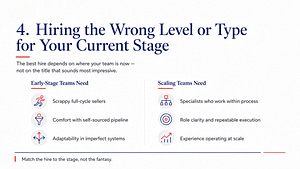
Founders sometimes bring in a senior VP too early expecting them to figure everything out. Or they hire enterprise closers when the biggest need is someone comfortable generating their own pipeline.
Reality check: Match the hire to where you actually are. Early-stage teams usually need scrappy, full-cycle people. Scaling teams need specialists who can operate within the process. Be honest about the environment you’re offering.
Suggested Read – When Hiring Sales Talent for Long Sales Cycles: What Actually Works in 2026
5. Treating Onboarding as a Quick Handover

Even strong hires fail when they’re given a login, a territory, and “go figure it out.” Long ramp times and unclear expectations kill momentum fast.
What works: Build a real 90–180 day plan with milestones, paired selling, regular deal reviews, and manager coaching. Treat the first few months as an investment, not a cost.
The Bottom Line
The organizations that get sales hiring right treat it as a strategic process, not a reactive scramble. They document what good looks like for their motion, assess candidates rigorously against that standard, hire for fit over flash, and support new reps with strong onboarding and coaching.
When you stop repeating the common mistakes, hiring stops being a gamble and starts becoming a predictable advantage.
If your sales growth feels slower or more painful than it should, take a fresh look at how you’re bringing people onto the team. Small improvements in process and criteria can save you a fortune and accelerate results faster than almost anything else you can do.