

Most sales teams miss their targets. Not because the reps are lazy. Not because “the market is tough.” And not even because the product is weak.
In our work with B2B sales organizations, we’ve seen the same pattern again and again: hardworking teams with decent products and decent leads still falling short quarter after quarter. The real reasons are quieter. They’re systemic. They hide in plain sight inside processes, habits, and leadership blind spots.
Practical Ways to Improve Sales Performance –
Here are seven underrated reasons most sales teams miss their targets, and what actually moves the needle.
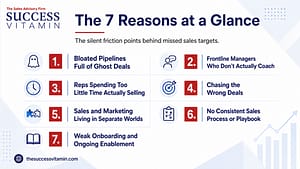
1. Bloated Pipelines Full of Ghost Deals
This is one of the most common and most damaging issues we see. Deals sit in the pipeline for months with no real movement. Reps and managers are afraid to disqualify opportunities, so the forecast becomes fiction.
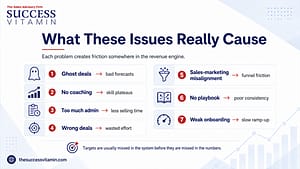
When pipeline hygiene is poor, everyone loses. Forecasting becomes guesswork. Coaching becomes impossible because no one knows what’s real. And reps waste time on deals that were never going to close.
Fix: Implement strict stage exit criteria and run weekly pipeline hygiene reviews. Make “no decision” an acceptable and encouraged outcome. The teams that get ruthless about cleaning their pipeline almost always see forecast accuracy and win rates improve within one or two quarters.
2. Frontline Managers Who Don’t Actually Coach
Many sales managers spend their days in meetings, putting out fires, and updating forecasts. Actual coaching, listening to calls, giving specific feedback, developing skills, falls to the bottom of the list.
Yet 75% of reps say having a coach or mentor makes them more likely to hit quota. When managers aren’t regularly reviewing calls and running structured 1:1s focused on skill development, reps plateau. The gap between top performers and everyone else widens.
Fix: Make coaching non-negotiable. Require managers to listen to a minimum number of calls per week and document feedback. Tie part of a manager’s variable pay to the development and quota attainment of their team, not just their own numbers.
3. Reps Spending Too Little Time Actually Selling
This one surprises leaders. Many reps are spending less than 30% of their time in front of customers or prospects. The rest gets eaten by CRM updates, internal meetings, report requests, and switching between too many tools.
When reps are overwhelmed by admin and technology (42% say they feel overwhelmed by their tech stack), they have less energy and less time for the activities that actually move deals forward.
Fix: Audit how reps are spending their time. Ruthlessly cut low-value internal work. Consolidate tools where possible. Protect deep work blocks for prospecting and deal work. The highest-performing teams we work with treat selling time as sacred.
4. Chasing the Wrong Deals
This is surprisingly common and incredibly expensive. Reps (and sometimes leaders) chase logos or any deal that shows movement instead of focusing on the right fit.
Poor qualification discipline means reps invest months in opportunities that were never a good fit. They single-thread deals instead of multi-threading across the buying committee. They stay in “hope mode” instead of rigorously testing for real buying intent.
Fix: Get serious about qualification frameworks (MEDDIC, MEDDPICC, or your own version). Run regular deal reviews that focus on fit, not just stage or size. Celebrate smart disqualifications the same way you celebrate wins. Top performers spend far more time on high-fit deals than average reps do.
5. Sales and Marketing Living in Separate Worlds
When sales and marketing aren’t tightly aligned on ICP, messaging, and buyer journey stages, reps are left trying to sell with content and positioning that doesn’t match how buyers actually buy.
We see this constantly. Marketing creates assets that sound good in the boardroom but don’t help reps have better conversations. Sales complains about lead quality while marketing complains about poor follow-up. Both are right, and both are losing.
Fix: Create shared ownership of the revenue funnel. Run joint ICP and buyer persona workshops. Measure and improve SQL-to-opportunity conversion together. The best revenue teams we work with treat sales and marketing as one integrated function, not two warring departments.
6. No Consistent Sales Process or Playbook
When every rep sells their own way, you don’t have a sales team, you have a collection of individual contributors. Forecasting becomes unreliable. Coaching becomes subjective. New hires take forever to ramp because there’s no standard to follow.
Without a clear, enforced sales process and common language, every deal becomes a one-off. Win rates suffer. Ramp times lengthen. And the organization can’t scale.
Fix: Define and document your sales process with clear stage definitions and exit criteria. Train everyone on it relentlessly. Review deals against the process, not just the outcome. The companies that treat their sales methodology as a living system (not a one-time training) see the biggest lifts in consistency and predictability.
7. Weak Onboarding and Ongoing Enablement
Many companies throw new reps into the deep end and hope they swim. For complex B2B sales with long cycles and sophisticated buyers, this approach is brutal.
Even experienced hires need deep product knowledge, buyer insight, and process fluency before they can perform. Without structured onboarding and ongoing enablement (not just one-off training), ramp times stretch and early turnover spikes.
Fix: Build a proper 90–180 day ramp plan with clear milestones. Pair new reps with mentors. Invest in continuous enablement, role-plays, deal reviews, and skill workshops, not just product training. The best teams treat enablement as an ongoing investment, not a cost center.
These seven issues don’t get the same attention as “we need more leads” or “the market is tough.”

But in our experience, they’re often the real reasons good teams with good products still miss their numbers.
The good news?
Every single one of them is fixable. It starts with leaders being willing to look at the system, not just the salespeople, and make the sometimes uncomfortable changes in process, coaching habits, and alignment that actually drive performance.
If your sales team is consistently missing targets, stop looking for the one big thing. Start auditing these quieter, underrated issues. The teams that win in 2026 and beyond won’t necessarily be the ones with the best reps. They’ll be the ones with the least amount of silent friction in their system.