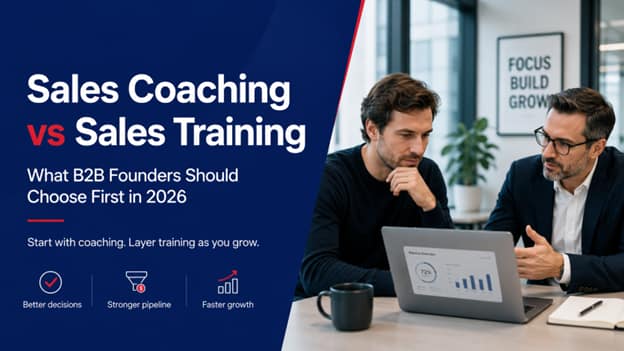
As a B2B founder, you’re constantly told you need to “fix your sales.” But when you start looking for help, you quickly run into two options: sales training programs and sales coaching. The big question most founders ask is: sales coaching vs sales training, which one should you choose first?
The answer isn’t as simple as picking one. But for most founder-led B2B startups, the smarter first move is usually sales coaching.
Let me break down the real difference between the two and why the order matters so much for scaling revenue without wasting time or money.
What Is Sales Training?
Sales training is structured learning. It’s usually delivered as workshops, online courses, or bootcamps. The focus is on teaching specific knowledge and tactics:
- Product knowledge
- Sales methodologies (SPIN, MEDDIC, etc.)
- Objection handling scripts
- Demo best practices
- Closing techniques
It’s great for onboarding new reps or rolling out a new process. Training gives your team the “what”, the foundational information they need to sell.
But here’s the catch: training is often a one-time event. Reps (or founders) sit through it, feel motivated for a week or two, and then slowly slip back into old habits.
What Is Sales Coaching?
Sales coaching is completely different. It’s ongoing, personalized guidance focused on behavior change and real-world application. A good coach observes your actual sales calls, reviews deals, asks tough questions, and helps you improve decision-making in live situations.
Instead of teaching you another script, B2B sales coaching helps you:
- Think strategically about complex deals
- Qualify opportunities faster and more accurately
- Build better stakeholder maps
- Make smarter go/no-go decisions
- Develop your own authentic selling style
Coaching turns knowledge into consistent performance.
Suggested Read – 10 Ways Sales Coaching Converts Sales Challenges into Opportunities
Sales Coaching vs Sales Training: The Key Differences
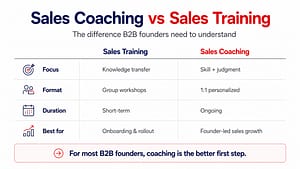
Here’s a clear side-by-side:
- Focus: Training transfers knowledge → Coaching builds skill and judgment
- Format: Training is group-based and event-driven → Coaching is one-on-one and ongoing
- Duration: Training is short-term → Coaching is continuous
- Outcome: Training improves awareness → Coaching drives measurable behavior change and results
Most B2B companies over-invest in training and under-invest in coaching. That’s why so many founders complain that their team “knows what to do but still isn’t doing it.”
Why B2B Founders Should Usually Choose Sales Coaching First
As a founder, you already have deep product knowledge and passion for your solution. What you typically lack is consistent process, sharp deal qualification, and the ability to scale your own selling effectiveness.
This is exactly where sales coaching for B2B leaders shines.
Good coaching helps you:
- Shorten sales cycles by making better decisions early
- Stop wasting time on deals that will never close
- Build repeatable systems you can later teach to your first hires
- Improve forecasting accuracy
I’ve seen multiple founder-led startups go from chaotic founder-led sales to predictable revenue after a few months of focused coaching, often faster than they would with another training program.
Quick read – The Role of Ongoing Sales Training in Shortening Long B2B Sales Cycles
When Sales Training Makes Sense
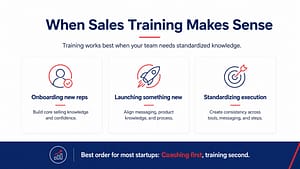
Training isn’t useless. It’s actually very valuable in specific situations:
- When onboarding new salespeople
- When launching a new product or major messaging change
- When your team needs standardized knowledge on tools or processes
The best approach for most B2B startups is this sequence: Start with sales coaching to build strong habits and decision-making, then layer in targeted sales training as you grow and hire.
The Bottom Line for Founder-Led B2B Startups
Sales coaching vs sales training isn’t really an either/or question, you eventually need both. But if you’re a B2B founder trying to break through the early revenue plateau, start with coaching. Training gives you the playbook. Coaching teaches you how to read the field, make smart calls in real time, and continuously improve. For most founder-led teams, that’s the missing piece.
If your sales feel inconsistent, your pipeline is bloated with bad deals, or you’re tired of being the only one who can close, it’s probably time to explore B2B sales coaching first. The right coach won’t just help you close more deals today, they’ll help you build a sales engine that scales long after you stop doing all the selling yourself. Ready to move beyond generic training? Consider whether sales coaching is the better first step for your stage.